ADDIE & REFLECTION
WHAT IS ADDIE ?
Addie is an acronym for the five stages of a development process: Analysis, Design, Development, Implementation, and Evaluation. The ADDIE model relies on each stage being done in the given order but with a focus on reflection and iteration. The model gives you a streamlined, focused approach that provides feedback for continuous improvement.
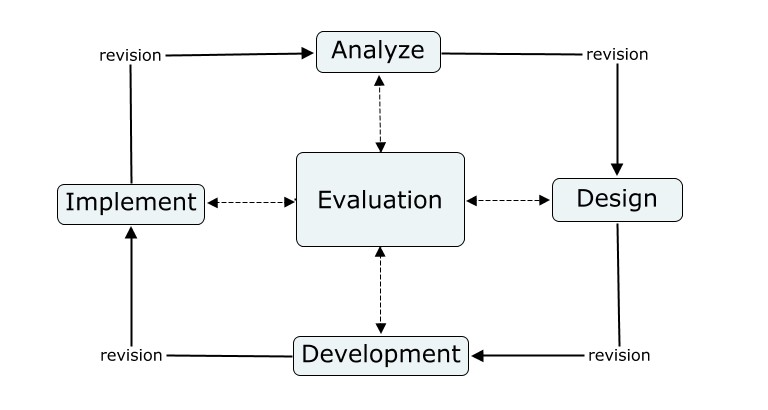
Instructional System Design (ISD): Using the ADDIE Model
Analysis
The Analyze phase is the foundation for all other phases of instructional design. During this phase, you
must define the problem, identify the source of the problem and determine possible solutions.
The phase may include specific research techniques such as needs analysis, job analysis and task analysis.
The outputs of this phase often include the instructional goals, and a list of tasks to be instructed. These
outputs will be the inputs for the Design phase.
Design
The Design phase involves using the outputs from the Analyze phase to plan a strategy for developing the
instruction. During this phase, you must outline how to reach the instructional goals determined during
the Analyze phase and expand the instructional foundation.
Some of the elements of the Design Phase may include writing a target population description, conducting
a learning analysis, writing objectives and test items, selecting a delivery system, and sequencing the
instruction. The outputs of the Design phase will be the inputs for the Develop phase.
Development
The Develop phase builds on both the Analyze and Design phases. The purpose of this phase is to
generate the lesson plans and lesson materials. During this phase you will develop the instruction, all
media that will be used in the instruction, and any supporting documentation. This may include hardware
(e.g., simulation equipment) and software (e.g., computer-based instruction).
Implementation
The Implementation phase refers to the actual delivery of the instruction, whether it's classroom-based,
lab-based, or computer-based. The purpose of this phase is the effective and efficient delivery of
instruction. This phase must promote the students' understanding of material, support the students'
mastery of objectives, and ensure the students' transfer of knowledge from the instructional setting to the
job.
Evaluation
This phase measures the effectiveness and efficiency of the instruction. Evaluation should actually occur
throughout the entire instructional design process - within phases, between phases, and after
implementation.
Evaluation
May be Formative or Summative.
Formative Evaluation is ongoing during and between phases. The purpose of this type of evaluation is
to improve the instruction before the final version is implemented.
Summative Evaluation usually occurs after the final version of instruction is implemented. This type
of evaluation assesses the overall effectiveness of the instruction.
PERSONAL REFLECTION
For our personal reflection, we find that LMS tools such as ED modo and Blendspace are very important to teachers. Firstly for ED modo, resources that can be shared. Student can refer as a note while teachers can use it as references and teaching materials. These include websites, embedded Youtube clips, flipped task links, files, documents and images. This is fantastic as it means we are saving paper and we are showing students a solid range of resources without them needing to 'google' something. Secondly, feedback allows us to give feedback to our students. We do this in a range ways. For example, replying to their posts asking them to edit certain parts or expand on others. We can even create a video rubric and sent them to link so they can listen to our marking orally and make changes. This immediate feedback keeps students remain on task and it is quick and easy for us to do.
While for Blendspaces, it is very benefits to the students, Blendspace also benefits to teachers in many ways, especially when creating lesson plans for the online classroom. For instance, Blendspace allows teachers to share learning materials with other users like students and fellow teachers.
This is the link for our BlendSpace.
This is the link for our Edmodo
Then, for the creativity tools we use ToonDoo and Pixton which is mostly easy to use but have prons and cons. The prons are it easy to use for the teachers to make fun game, quiz or notes for the students be more exciting to learn. But it also have some cons. The cons are It need to be use with internet which is the teachers in the rural area are mostly need to go to the town or find a place that have internet to use it. It also a bit difficult to use if the teachers are the beginers by using all of the tools.

This comic that we are using are from Pixton.


And these are from ToonDoo.


Comments
Post a Comment